Public adjusting news
Kentucky Just Took the Homeowner's Negotiator Off the Table. Here's Why That Should Worry You.
Since 2009, I've sat at kitchen tables with families who just lost their homes to fire, wind or storm. Most of them had never filed a big insurance claim before. They didn't know how to price a rebuild, read a 40-page policy, or push back when the first offer came in low. The insurance company did, because it has adjusters, estimators, engineers and attorneys whose whole job is settling claims.
That gap is why public adjusters exist. Now Kentucky has made it a lot wider.
What happened
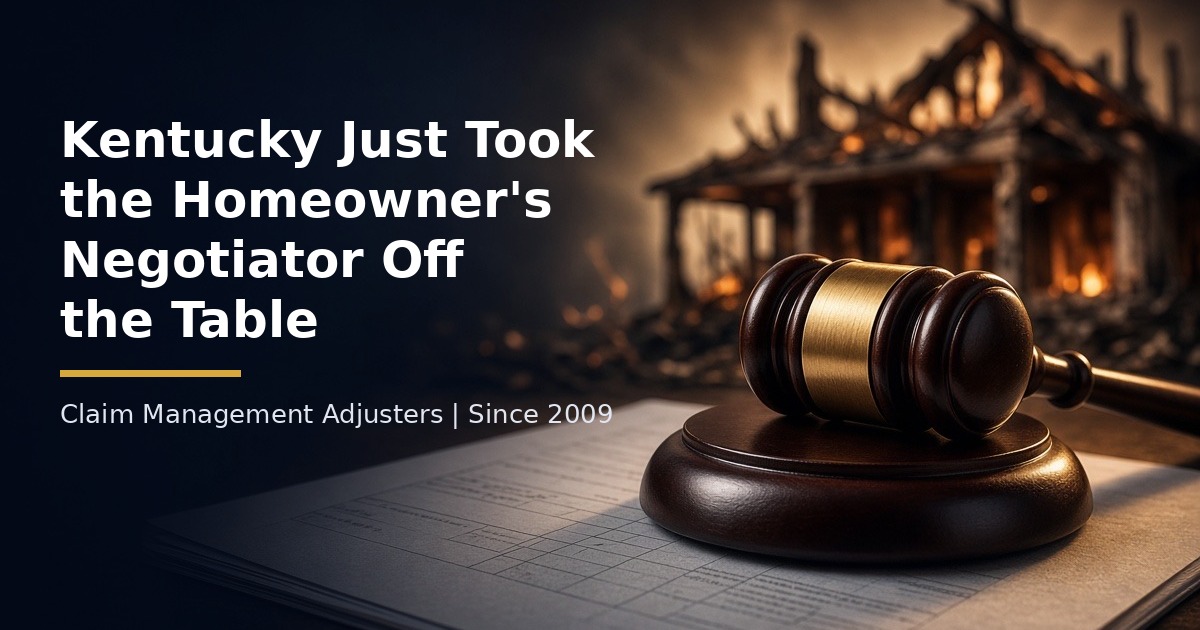
Kentucky passed House Bill 568, a law that bars licensed public adjusters from negotiating a claim on the homeowner's behalf. A group of adjusters challenged it in court. On October 28, 2026, a Jefferson County judge threw out their case and let the law stand.
Under the law, a public adjuster in Kentucky can still inspect the damage, document the loss and write the estimate. But when the insurance company says "no" or "that's too much," the adjuster has to step aside. The homeowner has to negotiate on their own or hire a lawyer.
What I've seen firsthand
I can tell you from 17 years of doing this work that the estimate is only half the battle. The real money gets won or lost in the back-and-forth that comes after.
I've seen first offers that left out entire rooms. I've seen depreciation applied in ways the policy didn't allow, demolition and debris removal left off completely, and code upgrades ignored. I've seen families told a partial repair was "good enough" when the whole structure needed to come down. Most of the claims I've worked would have settled for far less, or not settled at all, if the homeowner had been left to negotiate alone. Not because they weren't smart, but because they were up against professionals while living in a hotel and trying to hold their family together.
"But public adjusters charge a fee"
That was one of the court's main reasons. Public adjusters charge homeowners, and the insurance company's adjuster doesn't.
But the company adjuster isn't free. The insurance company pays them, and they work for the insurance company. A public adjuster works for you. A fee for having someone on your side isn't a reason to take that option away, any more than it would be for a lawyer or an accountant.
Who really benefits?
Ask yourself this. If the insurance company keeps its full team of negotiators and the homeowner loses theirs, who comes out ahead? It isn't the family standing in the driveway looking at what's left of their house.
Good regulation of public adjusters makes sense: licensing, training, fair fee limits and real penalties for bad actors. We support all of that. But regulating a profession is very different from banning it from doing the very thing people hire it for.
Why it matters outside Kentucky
Laws like this tend to spread. If other states follow Kentucky's lead, homeowners across the country could lose the right to have an experienced advocate in their corner when it counts most.
What homeowners should do now
- Get help early. The sooner a professional documents the loss, the stronger your claim is.
- Don't accept the first offer without a second opinion. It's often a starting point, not the final number.
- Know your rights. Your policy is a contract, and you're entitled to what you paid for.
- Find out what your state allows. Rules for public adjusters vary from state to state.
We're still in your corner
Claim Management Adjusters has been helping families recover what they're owed since 2009, on fire, roof, wind and storm claims. We're licensed in Indiana, Ohio, Kentucky, Tennessee, Maryland, North Carolina, South Carolina and Georgia. If you've had a loss or think your claim was underpaid, call us for a free consultation at (844) 262-9110.
Source: Carroll v. Coleman, No. 26-CI-003349 (Jefferson Cir. Ct., Ky., Oct. 28, 2026), as reported by Chip Merlin, Property Insurance Coverage Law Blog, Oct. 30, 2026.
Claim Management Adjusters is a licensed public adjusting firm. This article is general information, not legal advice. Your policy language controls your coverage.