The first cold night of fall always goes the same way. The furnace kicks on for the first time since spring. Someone pulls the space heater out of the closet. The fireplace gets its first fire of the year. Your home starts asking more of its heating than it has in months.
That is exactly when heating fires start, and most homeowners never see the risk until it is in the living room.
The numbers behind heating season
- A leading cause of home fire deaths. U.S. fire departments responded to an estimated 37,365 home fires involving heating equipment each year from 2020 to 2024. These fires caused an estimated 417 civilian deaths, 1,260 injuries, and $1.2 billion in property damage a year (NFPA).
- Space heaters are the deadliest. Space heaters and heating stoves were involved in about 30 percent of home heating fires, but 73 percent of the deaths and 70 percent of the injuries (NFPA, 2020–2024).
- Chimney fires cost more than they look. Larger fires involving fireplaces or chimneys were only 6 percent of heating fires, but they caused nearly one-fifth (19 percent) of the direct property damage (NFPA).
- The risk climbs as it gets colder. Nearly half (46 percent) of home heating fires happen from December through February (NFPA).
- Too close is the top mistake. In larger residential heating fires, a heat source placed too close to things that can burn was the leading factor, at 27 percent (USFA, 2017–2019).
Where heating fires actually start
Space heaters too close to everything
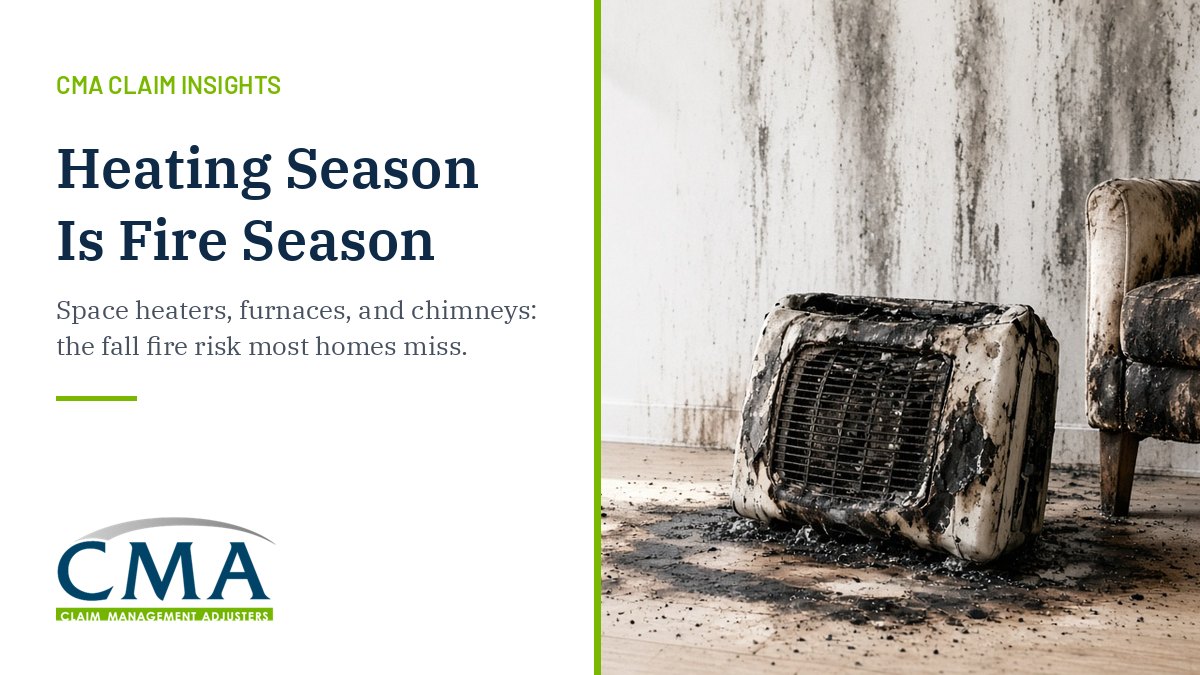
A space heater a foot from the couch, the curtains, the bedding, or a pile of laundry is how many of the worst heating fires begin. Portable heaters are easy to tip, easy to forget, and easy to run all night.
Furnaces after a long summer off
Dust, debris, and stored boxes collect around furnaces and utility rooms all summer. Then the system fires up for the season, often without an inspection.
Chimneys and fireplaces
Creosote builds up inside a chimney every time you burn wood. A dirty flue, a cracked liner, or embers that escape can start a fire inside the walls or the attic, out of sight.
Your heating-season checklist
- Three feet, every time. Keep anything that can burn at least 3 feet from space heaters, furnaces, fireplaces, and wood stoves.
- Turn space heaters off when you leave the room or go to bed. Plug them directly into the wall, not into an extension cord or power strip.
- Have the furnace inspected before the season, and clear the area around it.
- Have the chimney inspected and cleaned every year before your first fire. Use a sturdy screen, and let ashes cool completely in a metal container kept outside, away from the house.
- Test smoke alarms and carbon monoxide alarms, and keep a fire extinguisher where you can reach it.
If a heating fire happens: the first steps
- Get everyone out and call 911. Do not go back in until the fire department says it is safe.
- Document everything once you are allowed inside: photos and video of every room, including rooms the fire never reached.
- Do not throw anything away, and do not sign a release or accept a final payment in the first days.
- Keep every receipt for hotels, meals, and other costs. Your policy may cover additional living expenses.
- Call a public adjuster before the insurance company's estimate becomes the final word.
Their adjuster works for them. A public adjuster works for you.
After a heating fire, the insurance company sends its adjuster. That adjuster is hired and paid by the insurance company. A licensed public adjuster is hired by you and works only for you.
That difference matters most with smoke. A space heater fire in one room can push smoke and soot through the HVAC system, into wall cavities, closets, attic insulation, and nearly everything you own. A chimney fire can damage framing you cannot see. These losses are easy to under-scope on a first walk-through and expensive to fix later. Read more in Smoke and soot are part of the fire claim.
Claim Management Adjusters documents the full loss: the structure, smoke and soot, contents, and living expenses. We build the estimate line by line and negotiate for what your policy actually owes. There is no upfront fee. We are paid a percentage of the settlement as state law allows, and if there is no recovery, you owe CMA no fee. If you are weighing it, start with Why hire a public adjuster.
Had a heating fire? Get your own adjuster.
Jeremy W. Walls and Claim Management Adjusters represent homeowners in Indiana, Ohio, Kentucky, Tennessee, North Carolina, South Carolina, Maryland, and Georgia. The claim review is free.
- Office: 844-262-9110
- Mail: PO Box 509, Hartford City, IN 47348
Sources: NFPA, "Home Heating Safety" (heating fire statistics, 2020–2024 annual averages), nfpa.org/education-and-research/home-fire-safety/heating; U.S. Fire Administration, "Heating Fires in Residential Buildings (2017–2019)," Topical Fire Report Series v21i10. Public adjusting is licensed by state. CMA represents policyholders only where licensed and permitted. Fees and rules vary by state. This article is general information, not legal advice.