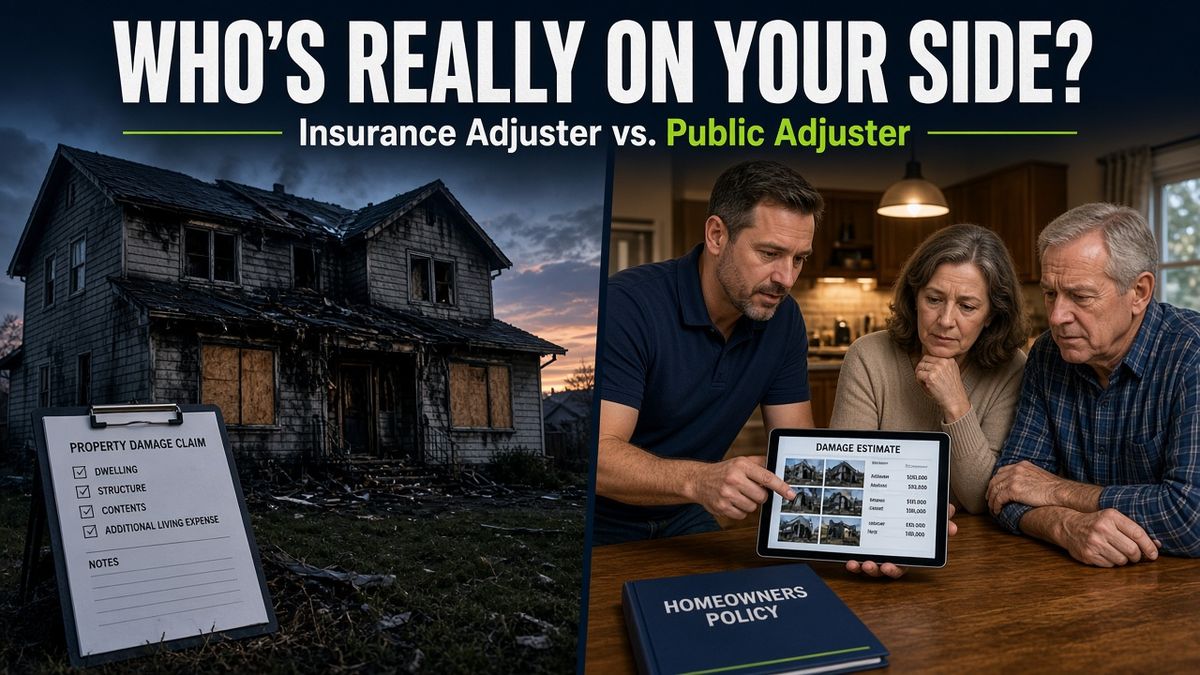
After a fire, a storm, a tornado, or a burst pipe, someone from the insurance company will call or come out to the house. That person is an adjuster. It is easy to assume they are your adjuster.
They are not. They are the insurance company's adjuster.
That is not an accusation. Many company adjusters are capable, fair people doing a hard job. But two adjusters can stand in the same burned kitchen, look at the same damage, and work for two different clients. Knowing who works for whom is the first thing every homeowner should understand about a claim.
Who each adjuster works for
The insurance company's adjuster
The adjuster the carrier assigns is hired, trained, and paid by the insurance company. Their job is to evaluate the loss for the company under the company's guidelines. Their client is the carrier.
There are two common kinds:
- Staff adjusters. Employees of the insurance company. They handle claims full-time for that one carrier.
- Independent adjusters. Contractors the carrier hires, often in large numbers after a big storm. They are not on the company payroll, but they are still working for the insurance company on your file. After a catastrophe, many are handling a heavy caseload far from home.
A public adjuster
A public adjuster is licensed by the state to represent the policyholder. You hire them. You sign the contract. Their duty is to you.
At Claim Management Adjusters (CMA), our only client on your file is you. We do not work for insurance companies, and we do not take money from contractors.
Side by side
| Insurance company adjuster (staff or independent) | Public adjuster | |
|---|---|---|
| Works for | The insurance company | You, the policyholder |
| Who hires them | The carrier | You |
| Who pays them | The carrier (salary or per-claim fee) | You — usually a percentage of the settlement |
| Builds the estimate | For the carrier's file | For your claim, room by room |
| Contents inventory | Reviews what you submit | Helps you build and price it |
| Reads the policy | Applies the carrier's position | Looks for every coverage that applies to your loss |
| Negotiates | On the company's behalf | On your behalf, where state law allows |
| Cost to you | No direct fee | Contingency fee, regulated by state; free consultation |
What a public adjuster actually does
A real claim is a second job. A public adjuster takes most of that job off your plate.
- Documents the damage. Photos, video, measurements, moisture readings, and notes — including smoke, soot, and water damage that is easy to miss on a first walk-through.
- Builds a detailed estimate. We write estimates in Xactimate, the same estimating software most carriers use, so both sides are working in the same language, line by line.
- Builds the contents inventory. After a fire, families may need to list hundreds or thousands of items. We help you build and price that list so it is not left half-done.
- Supports living expenses (ALE). If you cannot live in the home, your policy may cover additional living expenses. We help document rent, meals, mileage, and other costs so they get submitted.
- Reads the policy. Coverage for the dwelling, other structures, contents, and loss of use. Replacement cost and depreciation. Code upgrades, matching, and limits. We read your policy against your damage.
- Negotiates and supplements. We present the claim, answer the carrier's requests, and submit supplements when more damage shows up during repairs.
- Tracks deadlines. Proof of loss dates, recoverable depreciation windows, and other time limits in your policy.
When to hire one
Not every claim needs a public adjuster. A small, simple claim may settle fine on its own. These are the situations where representation tends to matter most:
- Large or total losses, where the dollars and the details add up fast.
- Fire and smoke damage, which often travels farther than it looks — into HVAC, wall cavities, and contents.
- A denied claim or an offer that seems low compared to what it will cost to put the house back.
- Complex claims — multiple types of damage, code upgrade issues, mortgage company involvement, or a long list of contents.
- You are overwhelmed. You are displaced, working, caring for family, and the claim keeps asking for more.
How public adjusters are paid
Most public adjusters, including CMA, work on a contingency fee: a percentage of the insurance settlement on the claim. There is no upfront fee, and if there is no recovery, you do not owe CMA a fee.
The fee percentage, the contract wording, and your right to cancel are regulated by each state, and the rules differ from state to state. Some states cap the fee, and some set lower limits for catastrophe claims or for money the carrier had already offered before you hired a public adjuster. We will explain exactly how the rules apply where your property is — in writing, before you sign anything.
Your first consultation is free. We will look at what happened, what has been offered, and whether we can help. If we do not think we can add value, we will tell you.
It is usually not too late
Many people think they missed their chance once a claim is open or a check arrives. Often, that is not the case. A public adjuster can step in after the claim is filed, after the first inspection, and after an offer has been made.
There are limits. Your policy has deadlines, and some states have rules about timing and fees after an offer. The sooner you call, the more options you usually have. If you can, talk to someone before you sign a release or accept a final payment.
Questions to ask before you hire a public adjuster
- Are you licensed in my state? Check with your state's Department of Insurance. A public adjuster must be licensed in the state where the property is located.
- Are you bonded? Most states require public adjusters to carry a bond.
- What is your fee, and is it in the contract? Get it in writing. Ask about your right to cancel.
- Can I talk to past clients? Ask for references from claims like yours.
- Do you have ties to a contractor on my job? Your public adjuster should be working for you, not a restoration company.
Frequently asked questions
Can a public adjuster guarantee a bigger settlement?
No — and you should be cautious of anyone who promises one. Every claim is different. What a good public adjuster does is document the loss thoroughly, build a complete estimate, and negotiate for what your policy actually owes.
Is a public adjuster the same as a lawyer?
No. A public adjuster handles the claim — damage, estimates, documentation, and negotiation. A public adjuster does not give legal advice. If a claim turns into a legal dispute, you may need an attorney.
What if the insurance company's adjuster has already been out?
That is fine, and common. We can review their estimate, compare it with the damage, and help you respond.
Do I still have to work with my insurance company?
Yes. Your policy still requires your cooperation. A public adjuster helps you meet those duties and handles much of the back-and-forth for you.
Get your own adjuster on your side
The insurance company has its adjuster. You can have yours.
Claim Management Adjusters has been protecting the insured since 2009. Jeremy W. Walls is a licensed public adjuster in Indiana, Ohio, Kentucky, Tennessee, North Carolina, South Carolina, Maryland, and Georgia. If your home was damaged by fire, storm, tornado, or water, call for a free claim consultation. No pressure, and no cost to find out where you stand.
- Office: 844-262-9110
- Cell: 765-748-8081
- Web: www.claimmanagementadjusters.com
- Mail: PO Box 509, Hartford City, IN 47348
Public adjusting is licensed by state. CMA represents policyholders only where licensed and permitted. Fee limits, contract terms, and what a public adjuster may do vary by state. This article is general information, not legal advice.