Thanksgiving is supposed to be about the table, not the fire department. But year after year, the national numbers say the same thing: more home cooking fires start on Thanksgiving Day than on any other day of the year.
Here is what the data shows, how to keep your own kitchen off that list, and what to do if a holiday fire does happen at your house.
What the numbers say
- About four times the normal number of cooking fires. The National Fire Protection Association (NFPA) estimates that 1,446 home cooking fires were reported to U.S. fire departments on Thanksgiving Day in 2023. That is 388 percent above the daily average. Christmas Day and Christmas Eve came in second and third.
- Cooking causes most Thanksgiving fires. From 2019 to 2023, cooking accounted for 80 percent of U.S. home fires on Thanksgiving Day, according to NFPA.
- More than twice as many residential fires overall. The U.S. Fire Administration (USFA) reports an average of about 2,300 residential building fires on Thanksgiving Day each year from 2017 to 2019. That is 2.3 times the number on other days, with an estimated $26 million a year in property loss.
- The danger zone is the middle of the day. USFA found that more than half (54 percent) of Thanksgiving Day residential fires happened between 10 a.m. and 5 p.m., while dinner was being made, not at the usual evening dinner hour.
The leading factor in home cooking fires, NFPA says, is cooking left unattended. With a full oven, every burner going, and a house full of guests, it is easy to step away for a minute.
A short safety checklist
- Stay in the kitchen while anything is on the stovetop, especially oil. If you are roasting a turkey, stay home and check it regularly.
- Use timers for long cook times so nothing gets forgotten.
- Keep a three-foot zone around the stove clear of towels, oven mitts, packaging, and wooden utensils, and keep kids and pets out of it.
- Keep a lid next to the pan. For a small grease fire, slide the lid on, turn off the burner, and leave it covered. Never use water on a grease fire.
- Oven fire? Turn off the heat and keep the door shut. If you have any doubt, get out and call 911.
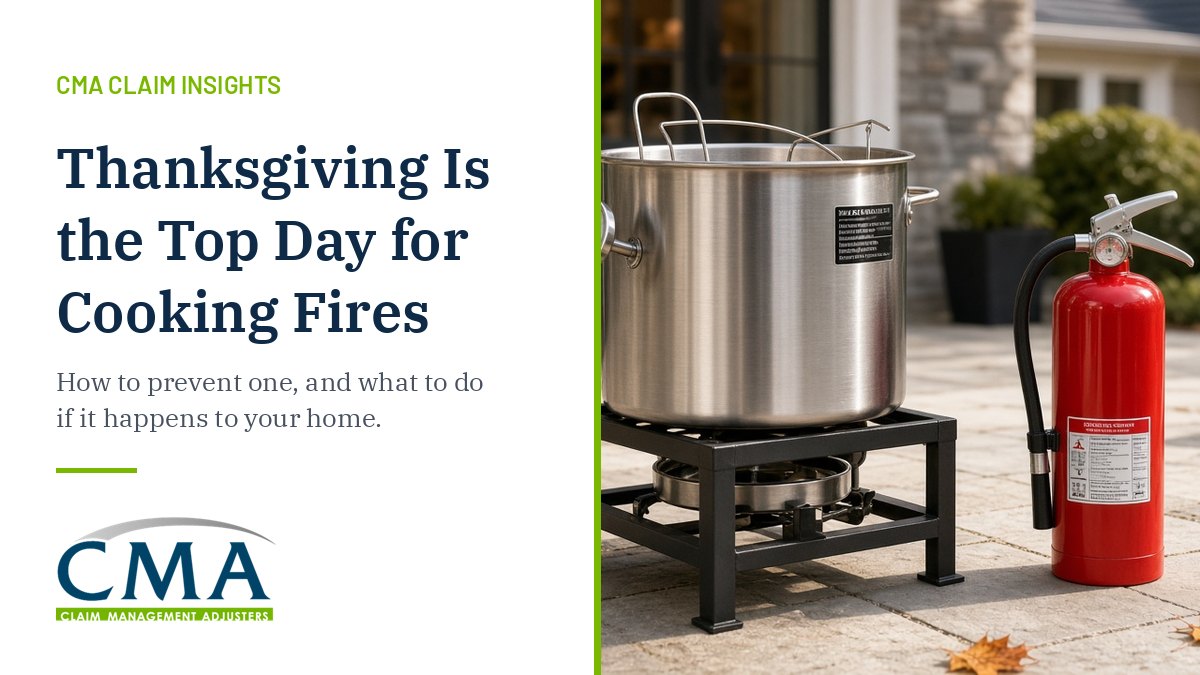
- Think twice about an oil turkey fryer. NFPA strongly discourages oil-filled turkey fryers because of the risk of serious burns. If you want fried turkey, NFPA suggests buying one already cooked or using an oil-free fryer. If you fry anyway, do it outdoors, well away from the house, garage, and deck, on a flat surface, with a fully thawed and dry bird, and never leave it unattended.
- Test your smoke alarms before guests arrive, and keep a fire extinguisher where you can reach it.
If a fire happens: first hours
- Get everyone out and call 911. People first. Everything else can be replaced.
- Do not go back in until the fire department says it is safe.
- Take photos and video of every room once you are allowed inside, including rooms the fire never touched. Smoke and soot travel.
- Do not throw anything away yet, and do not sign a release or accept a final check from the insurance company in the first few days.
- Keep every receipt for hotels, meals, and other costs if you cannot stay in the home. Your policy may cover additional living expenses.
Why you want your own adjuster
After a fire, the insurance company will send its adjuster. That adjuster works for the insurance company. A licensed public adjuster works for you.
Kitchen fires are often bigger claims than they look. A grease fire on the stove can leave soot in the cabinets, the ductwork, the attic, and the closets down the hall. It can damage the contents of the whole house and keep a family out of the home for weeks. Those losses are easy to miss on a first walk-through, and they do not belong on a "clean the kitchen" estimate.
Claim Management Adjusters documents the full loss: structure, smoke and soot, contents, and living expenses. We build the estimate line by line and negotiate with the insurance company for what your policy actually owes. There is no upfront fee. We are paid a percentage of the settlement, as state law allows, and if there is no recovery, you owe CMA no fee.
Had a holiday fire? Call before you settle.
Jeremy W. Walls and CMA represent homeowners in Indiana, Ohio, Kentucky, Tennessee, North Carolina, South Carolina, Maryland, and Georgia. The claim review is free.
- Office: 844-262-9110
- Mail: PO Box 509, Hartford City, IN 47348
Sources: NFPA, "Thanksgiving is leading day of the year for U.S. home cooking fires" (Nov. 11, 2025); U.S. Fire Administration, "Data snapshot: Thanksgiving Day fires in residential buildings (2017–2019)." Public adjusting is licensed by state. CMA represents policyholders only where licensed and permitted. Fees and rules vary by state. This article is general information, not legal advice.